
Eighteen thousandths. That is what Toto Wolff gave Sky Sports F1: George Russell’s lead over Lando Norris at the moment Mercedes told him to abandon his lap, in Q3, in the second sector, on a track still damp, because he was coming up on Alex Albon’s Williams.
I haven’t redone Interlagos to measure it. We’ve already done that here, and one delta a day is enough. What interests me is the other number, the 50-50. Wolff said: “It was a difficult decision, a 50-50, because George was coming up on Albon.” And just before that: “If we had a crystal ball to know whether to slow down or not, it would help us a lot.”
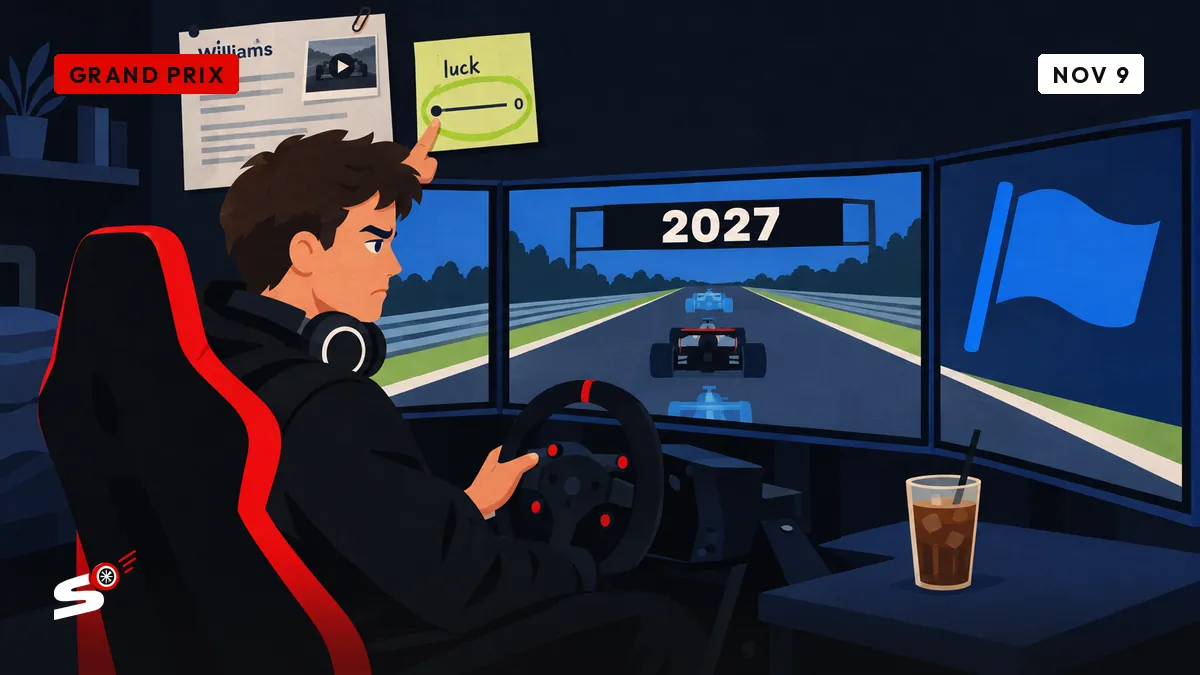
A crystal ball, in the sim, exists. It’s called the ghost. You start your lap, your ghost drives alongside, and you know to the thousandth whether to keep going. Nobody has ever abandoned a lap behind a ghost: it gets in nobody’s way, it’s transparent. Albon is not transparent. Unmodelled variable.
Then the rain came back, and Russell had no more attempts. He finished second, 204 thousandths off, and he believes his team took the pole from him. Wolff thinks the 18 thousandths would not have held, but he added that his driver “deserved to get it” and “was in a class of his own today”.
So everybody agrees about the driver. The disagreement is about the end of a lap that nobody saw. At my place, that gets settled in a minute twenty. In real life, it takes a conference.
A ghost that gets in nobody’s way, at the post, we call that Jean-Luc.
For Sunday it changes nothing to the sums anyway: a five-place penalty for a new internal combustion engine, so Russell starts seventh. Antonelli moves up to the front row alongside Norris, with Lawson and Hülkenberg in the top four. The ghost has no engine to change. In theory.
It’s true, we checked: F1i (Auto Journal).